
The short answer
Choose the 2-, 3-, or 4-day template you can repeat for the next 8 weeks. Make sure the week covers a knee-dominant leg exercise, a hip hinge, a push, and a pull. Then log attendance, sets, reps, and load so you can adjust from evidence rather than gym-plan anxiety.
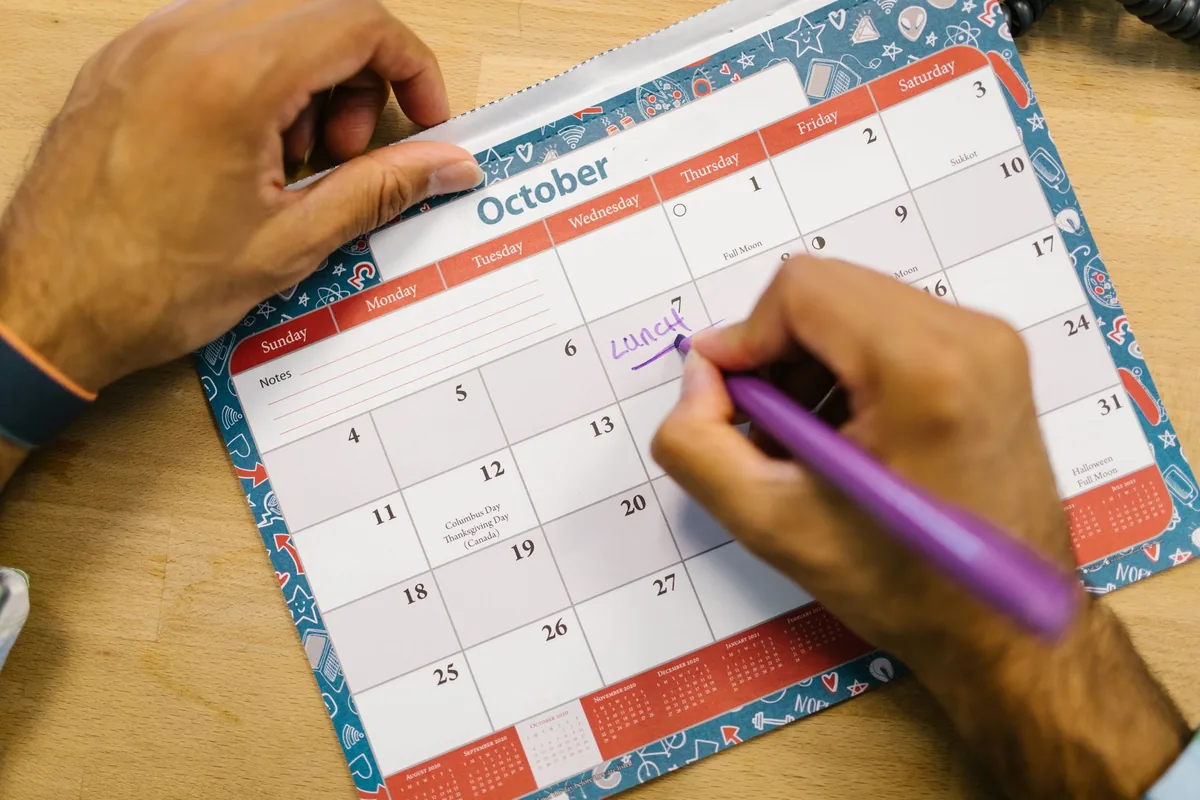
Your one action today: put the sessions on your calendar for 8 weeks. Do not change the template because you see a more exciting split online. Change it only if your log shows a problem with attendance, progress, or recovery.
You do not need the perfect split. A 2024 systematic review and meta-analysis found similar strength and muscle-growth results from full-body and split routines when weekly training volume was matched. The review included 14 studies and 392 participants, so it supports flexibility rather than proving that every schedule works equally well for every person.[1]
Use the Four-Check Week
Build your schedule in this order:
- Reliable days: How many sessions can you protect even during a busy week?
- Whole-body coverage: Where will you place the main movement patterns?
- Recoverable work: Can you repeat the week without declining performance, persistent soreness, or dread?
- Evidence: What will you log for 8 weeks before deciding whether the plan works?
This order matters. Choosing a named split first and trying to force your life around it creates more decisions. Starting with your real calendar gives you a week you can control.
Check 1: Pick your reliable number of days
Use the number you can complete in a difficult week, not your most optimistic week.
| If you can reliably train | Start with | Why |
|---|---|---|
| 2 days | Two full-body sessions | Every major area can still be trained across the week |
| 3 days | Three full-body sessions | Frequent practice without needing four protected days |
| 4 days | Upper/lower repeated twice | More room for sets while keeping sessions manageable |
Do not add a day just because more training sounds better. The 2026 American College of Sports Medicine position stand reviewed 137 systematic reviews and concluded that progressive resistance training reliably improves strength, muscle size, power, and physical function. Its broad findings support training major muscle groups at least twice per week for strength and using multiple sets, while many advanced programming variables did not consistently change outcomes.[2] The practical message for a beginner is simple: repeat useful work before adding complexity.
Want a deeper comparison of routine types? Read full-body vs split workouts. This guide stays focused on fitting the week to your life.
Check 2: Cover the body before specializing
Across the week, include these four movement categories:
- Knee-dominant legs: squat, leg press, split squat, step-up
- Hip-dominant legs: Romanian deadlift, hip thrust, cable pull-through, hamstring curl
- Push: dumbbell press, machine chest press, push-up, overhead press
- Pull: row, lat pulldown, assisted pull-up, band row
Then add one or two movements for your priorities: glutes, shoulders, arms, calves, or core. Beginners do not need every variation. They need enough coverage to practise the main patterns and a stable exercise list that makes progress visible.
Check 3: Set work you can recover from
Start with 2 working sets per exercise, usually leaving about 2–3 good-form reps in reserve. Use 4–6 exercises per session. After two weeks, add a third set to a movement only if technique is stable, soreness is manageable, and performance is holding or improving.
The 2026 ACSM review found that 2–3 sets per exercise supported strength and that higher weekly volume—around 10 or more sets per muscle group—can support hypertrophy.[2] That number is a population-level finding, not a quota every beginner must reach immediately. Sets from compound exercises also overlap: a press trains chest, shoulders, and triceps, while a row trains back and biceps.
Use these boundaries:
- Add work when you complete the planned week, recover before the next relevant session, and your reps or loads are progressing.
- Hold work steady when progress is occurring. More is not automatically better.
- Remove 2–4 weekly sets from the affected area when performance drops for two sessions, soreness changes how you move, or fatigue is disrupting normal life.
- Stop and get medical guidance for sharp pain, chest pain, faintness, unusual shortness of breath, or symptoms that feel different from ordinary training effort.
There is no universal recovery clock. Training age, exercise choice, effort, sleep, nutrition, health, and stress all change how quickly someone is ready again. When possible, avoid putting demanding sessions for the same area on consecutive days. Let your next-session performance help judge recovery.
Check 4: Decide what counts as evidence
For 8 weeks, record:
- whether you attended each planned session
- exercise, load, sets, and reps
- how many good-form reps you felt you had left on the final set
- pain or soreness that changed the next workout
- any schedule disruption that forced a change
At the end of 8 weeks, ask:
- Did I complete at least 80% of the planned sessions?
- Did reps, load, range of motion, or control improve on most key exercises?
- Could I recover well enough to repeat the week?
If attendance is low, simplify the schedule. If attendance is high but lifts are flat, review effort, technique, exercise choice, recovery, and food before adding days. If progress is steady, keep the plan.
A 2-day workout week
Use this when two days are the number you can protect consistently. Leave at least one non-lifting day between sessions when your schedule allows.
| Day A | Sets × reps | Day B | Sets × reps |
|---|---:|---|---:|
| Goblet squat or leg press | 2–3 × 6–12 | Split squat or step-up | 2–3 × 8–12 |
| Dumbbell bench or push-up | 2–3 × 6–12 | Overhead or machine press | 2–3 × 6–12 |
| Romanian deadlift | 2–3 × 6–12 | Hip thrust or leg curl | 2–3 × 8–15 |
| Cable, machine, or dumbbell row | 2–3 × 8–15 | Pulldown, assisted pull-up, or band row | 2–3 × 8–15 |
| Optional core, calves, arms, or glutes | 1–2 × 10–20 | Optional core, calves, arms, or glutes | 1–2 × 10–20 |
Example: Tuesday A, Saturday B. The days do not need to be Monday and Thursday. They need to be days you can keep.
A 3-day workout week
Use three full-body sessions with slightly different exercises. A Monday-Wednesday-Friday rhythm is convenient, but any three mostly non-consecutive days work.
| Day A | Day B | Day C |
|---|---|---|
| Squat or leg press | Romanian deadlift | Split squat or step-up |
| Dumbbell bench press | Overhead press | Incline or machine press |
| Seated row | Lat pulldown | One-arm row or assisted pull-up |
| Hip thrust | Leg curl | Glute bridge or cable pull-through |
| Optional priority exercise | Optional priority exercise | Optional priority exercise |
Start with 2 sets per exercise in the listed rep ranges from the 2-day plan. This keeps the first weeks manageable. If five exercises make sessions too long, do the first four. Coverage and repeatability matter more than finishing every optional movement.
Frequency is a way to distribute work, not a muscle-building trick by itself. A 2019 systematic review and meta-analysis found no meaningful hypertrophy advantage from higher training frequency when total weekly volume was equated.[3] Use three days because it fits your week and spreads the work—not because the calendar has magic powers.
A 4-day workout week
Use an upper/lower rotation when you can reliably protect four sessions:
| Session | Main work |
|---|---|
| Lower A | Squat or leg press, Romanian deadlift, optional glute or calf work |
| Upper A | Press, row, pulldown, optional shoulders or arms |
| Lower B | Split squat or step-up, hip thrust or leg curl, optional glute or calf work |
| Upper B | Overhead or incline press, row or assisted pull-up, optional shoulders or arms |
A common layout is Monday lower, Tuesday upper, Thursday lower, Friday upper. You can swap the order. Keep the two lower sessions and two upper sessions in the weekly loop.
For more exercise detail, use the upper/lower split guide. If you specifically want a women-focused four-day routine, see the 4-day workout split for women. Those pages answer split-specific questions; this framework helps you decide whether four days belong on your calendar at all.
The missed-session rules
A missed workout does not require a new plan. Use these rules:
- Continue the sequence. If you miss Day B, do Day B next. Do not skip it because the calendar says a different workout belongs on that weekday.
- Do not double up. Two full sessions in one day usually adds fatigue without fixing the reason you missed the first one.
- Do not cram the week. If moving a workout would create several hard days in a row, take the recovery day and continue afterward.
- Keep the important work when time is short. Do the first four movement categories for 1–2 sets. Drop optional accessories that day.
- After a full week away, repeat—do not test yourself. Return with the same exercises and slightly lighter loads or fewer sets if needed. Build back from how the first session feels.
Think of the plan as a repeating sequence, not a Monday-to-Sunday exam. This single rule prevents one disrupted day from becoming another complete restart.
Use one progression rule
Pick a rep range, such as 8–12, and keep the load the same until you can reach the top of the range for every planned set with controlled technique and about 1–2 good reps still available. Then increase the load by the smallest practical amount and return to the lower end of the range.
Example:
- Week 1: 10, 9 reps with 20 lb dumbbells
- Week 2: 11, 10 reps with 20 lb dumbbells
- Week 3: 12, 12 reps with 20 lb dumbbells
- Week 4: 9, 8 reps with 22.5 lb dumbbells
You will not progress every exercise every week. If an exercise stalls, first check whether you attended, repeated the same technique, and recovered. Read Progressive Overload Explained for more ways to progress without adding weight too quickly.
Substitute the pattern, not the entire plan
Equipment changes. The job of the exercise can stay the same.
| Pattern | Gym option | Limited-equipment option | No-machine option |
|---|---|---|---|
| Knee-dominant | Leg press | Goblet squat | Bodyweight split squat |
| Hip-dominant | Romanian deadlift | Dumbbell hip thrust | Single-leg glute bridge |
| Push | Chest-press machine | Dumbbell press | Incline or floor push-up |
| Pull | Cable row or pulldown | Dumbbell row | Band row |
Keep the substitute for several weeks so your log remains comparable. If an exercise causes pain, do not force a “similar” movement through the same pain. Stop, adjust, and seek qualified help when needed.
For help deciding which movements belong first, see compound vs isolation exercises.
What this framework cannot decide for you
These templates are general education, not individualized programming. They do not account for an injury, pregnancy or postpartum status, a medical condition, medication effects, disability-specific needs, competitive sport practice, or physically demanding work. They also have not been clinically validated as a specific 8-week program.
If you are new to exercise, have a health condition, are returning after injury or surgery, or are unsure whether resistance training is appropriate, ask a qualified healthcare professional or appropriately credentialed exercise professional for guidance. Stop exercising and seek urgent care for severe or sudden symptoms.
Where Soma fits—and where it does not
You can use this framework with paper, a notes app, or a spreadsheet. Soma is optional. It is a commercial fitness app that can keep your workout history, food log, and plan in one place, which may reduce the number of decisions you make each week. Using Soma does not make a poorly fitted schedule effective, and the templates in this article are not proof of a guaranteed result.
This article was written by Soma's editorial team using the research below. It was not presented as an independent product review or as a plan clinically tested by Soma. No expert or medical review is claimed.
Choose your template, calendar the next 8 weeks, and start the log. Let attendance, lifts, and recovery—not a search for the perfect split—tell you what to adjust.
Sources
- Ramos-Campo DJ, et al. Efficacy of split versus full-body resistance training on strength and muscle growth: a systematic review with meta-analysis. *Journal of Strength and Conditioning Research*. 2024. The analysis included 14 studies and 392 participants; results apply to the studied populations and programs, and certainty is limited by the underlying evidence.
- American College of Sports Medicine. Resistance Training Prescription for Muscle Function, Hypertrophy, and Physical Performance in Healthy Adults: An Overview of Reviews. 2026. See also the official ACSM summary infographic. This overview synthesized 137 systematic reviews; broad recommendations do not replace individualized programming.
- Schoenfeld BJ, Grgic J, Krieger J. How many times per week should a muscle be trained to maximize muscle hypertrophy? A systematic review and meta-analysis. *Journal of Sports Sciences*. 2019. When weekly volume was equated, training frequency did not meaningfully change hypertrophy in the included studies.